The Heptalogical Model of Entrepreneurship
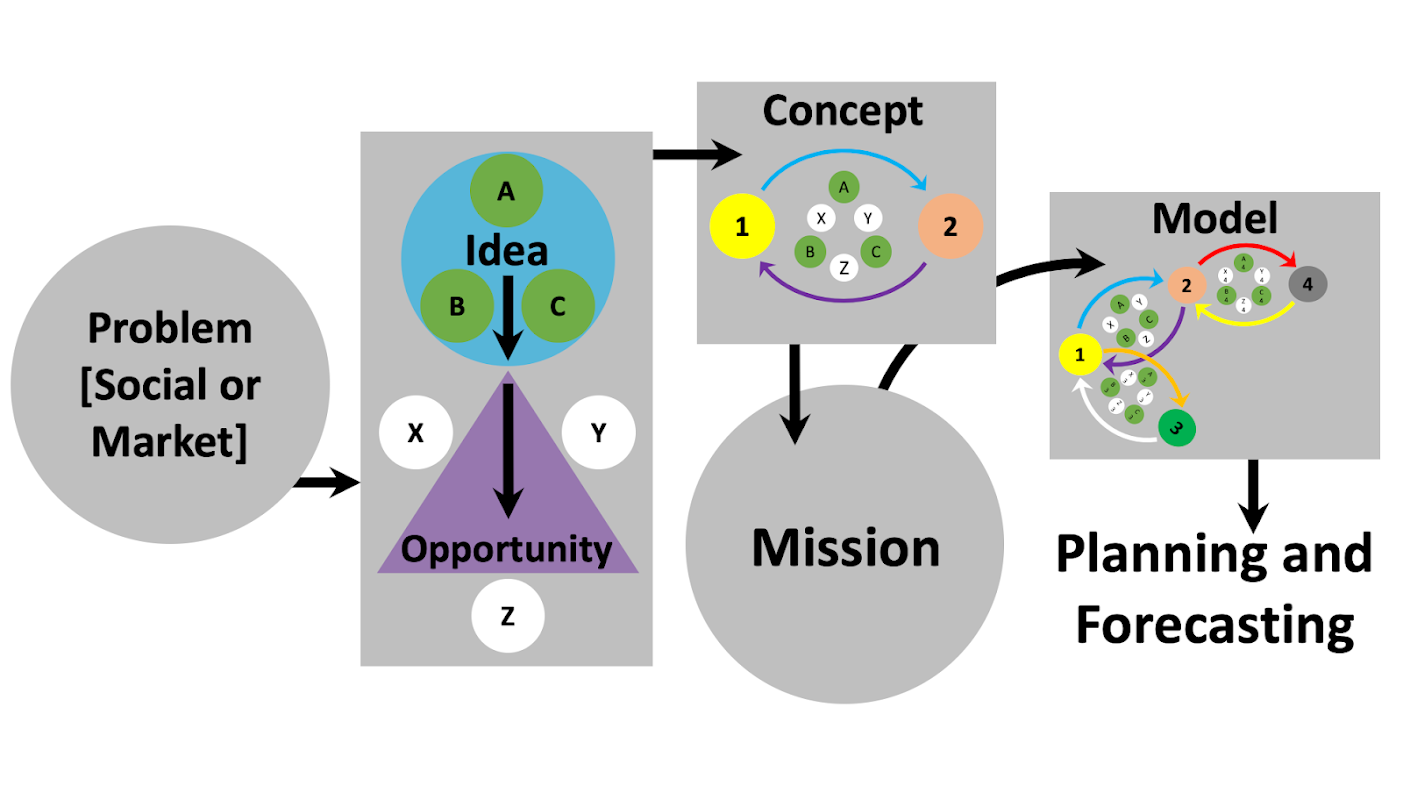
The seven elements
Tap an element to learn more.
The first three elements follow the logic of uncertainty; the last four follow the logic of risk.
IProblem [Social or Market]
Entrepreneurship starts with a social or market problem that some people, ideally many, perceive.
IIOpportunity
An opportunity is made of objective elements that exist whether anyone perceives them or not, but they are disconnected and need a novel way to be coordinated.
IIIIdea
An idea is a subjective notion, formed by one person, that coordinates the elements of the opportunity and fills the gaps between them.
IVConcept
The concept unites the opportunity and the idea in a core transaction: how the venture serves its market or constituency and generates value, makes money, or makes social impact.
VMission
The mission is a narrative that explains why the venture and its founders are motivated to engage the problem, not just what the venture does.
VIModel
Guided by a strong mission, the model is how the venture grows and adapts, building a diversified set of operations that subsumes multiple concepts and is more robust to change.
VIIPlanning and Forecasting
Planning and forecasting become easier when the earlier elements are clear, and mission-based diversification gives a sounder basis for forecasting performance.
Murphy, P. J., Hood, A. C., & Wu, J. (2019). The heptalogical model of entrepreneurship. Entrepreneurship Education and Pedagogy, 2(3), 188–213.
Read the paper